Build a Portfolio that Sells. Join our Free Bootcamp.
Designers Hate AI. They’re Also the Ones Who’ll Dominate It.
The Wrong People Are Panicking
Claude Design launched last week, and the design internet lost its mind.
If you missed it, Anthropic dropped a tool that generates prototypes, decks, and mockups, reads your company’s codebase and design files, and applies your design system automatically. Figma’s stock dropped the same day. My feed filled up with designers panicking, dunking, or posting long threads about how this proves AI will never understand “real design.”
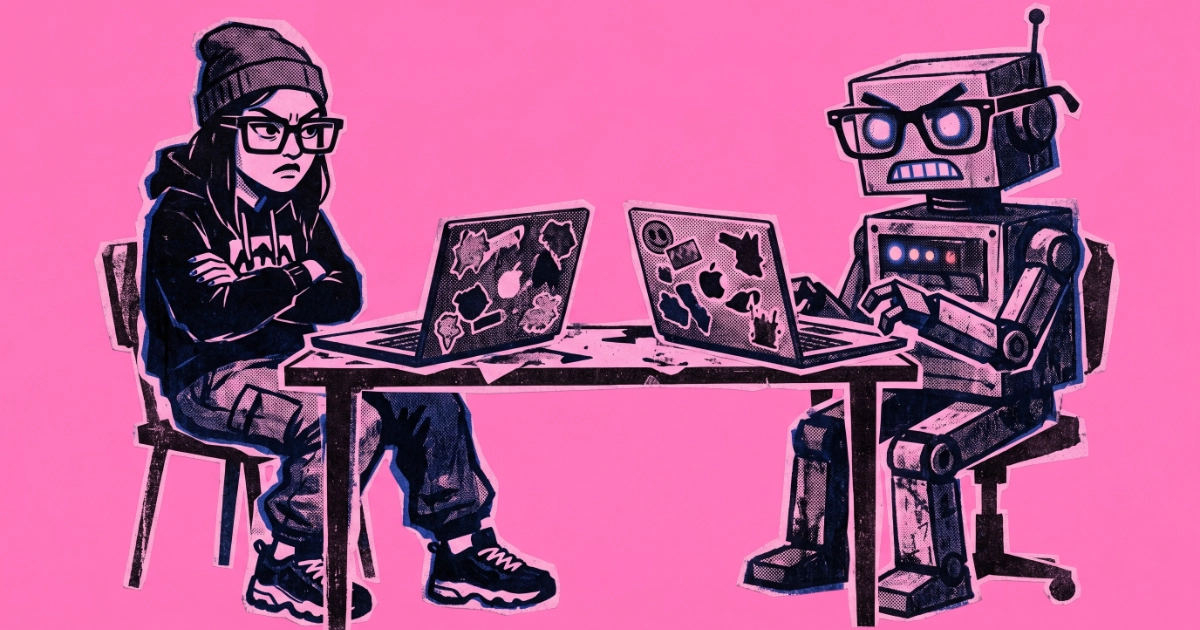
Designers hate AI more than any other profession I know. Which is wild, because they’re the ones most likely to dominate it.
And the panicking isn’t totally wrong. The output is a real jump from anything you could get out of Claude before, and most non-designers are going to look at what it produces and call it done. But if you actually stop to ask whether the messaging is landing, whether the design is amplifying the idea or just decorating it, you still need someone with taste to push it further. That’s the part designers keep missing in their posts.
That reaction, the reflexive defensiveness, is the whole problem. Go look at your feed. The loudest anti-AI voices in any creative circle are designers. Meanwhile developers are rebuilding their entire workflow around Claude Code, marketers are A/B testing AI campaigns in production, and product managers are using AI to prototype on their own without a designer in the room. Designers are the only group still treating AI like a moral question instead of a tool they’ll eventually have to reckon with.
Here’s the part that should really sting: of all those groups, designers are the ones who should be least afraid. The skills that actually define design, the ones school and good mentors drilled into you, are the exact skills AI structurally can’t do. And the designers dragging their feet the hardest are forfeiting the biggest advantage any creative profession has right now.
Who’s Actually Cooked
Let’s be honest about which jobs are genuinely at risk, because it’s not the one designers think.
Being a great developer means writing near-perfect code, knowing a handful of languages cold, following syntax and architecture rules without slipping, and executing a spec with precision. There’s creativity in problem solving, sure. But the bulk of what makes someone a strong coder is being really, really good at a rule-based system. That is the exact thing large language models are built to do. The best developers are already using AI to 10x their output, and the average ones are about to find out their ceiling just dropped.
Being a great accountant means knowing the numbers, knowing the rules, knowing where the rules can bend and where they can’t. It’s a discipline built on accuracy and pattern recognition inside a defined system. AI eats that for breakfast.
The pattern across every vulnerable profession is the same. If your job is defined by executing against a known set of rules with precision, AI is going to do most of it, faster and cheaper than you. That’s not a hot take, that’s just where the technology is strongest. Rule-based, high-volume, high-precision work is exactly what these models were built for.
Design is different, and it’s different in a way designers don’t give themselves enough credit for. But before we get to that, we need to talk about the thing every designer is actually afraid of.
Yes, Your Execution Skills Are Going Away
The thing the whole industry is tiptoeing around is the execution layer, so let’s just name it. The Figma expertise, the pixel pushing, the years you spent getting fast at building out screens and mastering auto-layout and nailing the perfect spacing, all of that is about to be worth a fraction of what it’s worth now. For a lot of designers, that craft was most of the job and a good chunk of the identity, and it’s uncomfortable to hear that a tool released last week can handle most of it in an afternoon.
And honestly, the hardest part of this isn’t even the career math. It’s that the craft itself is something designers genuinely love. Putting on headphones and disappearing into Illustrator for four hours working on one illustration, losing the afternoon in a layout until it finally clicks, that deep hands-on flow state is one of the best feelings in the job. That part is going to get smaller. Not gone, but smaller. You’re going to spend less time in the tool and more time thinking, directing, deciding. For a lot of designers that’s going to feel like something real got taken away, because it is.
The designers who spend the next year mourning the execution layer, though, are the ones who’ll get caught flat-footed, because your value was never really the pixels anyway. It was the thinking behind them, and the pixels were just the evidence of it. The industry conflated the two for years because you needed execution skills to prove the thinking, and because clients paid for deliverables they could see. What AI actually did was separate those two things, which means the thinking is now the job and the execution is now the machine.
That’s genuinely good news if you can stomach the transition. Right now most designers spend something like eighty percent of their week pushing rectangles and twenty percent doing the actual creative work, and that ratio is about to flip. It’s going to flip for the designers who let the rectangle-pushing part go, and it’s going to punish the ones who don’t.
What Designers Are Actually Trained In
Think about what a good design education actually teaches you. Not the software. Not the grid systems. The real curriculum, the stuff that separates a designer from a production artist, comes down to three things.
Empathy. Every UX class, every user interview, every redesign critique is an exercise in reading a human being. You’re trained to sit with someone else’s confusion, notice where they hesitate, understand why a button feels wrong even if they can’t articulate it. That is a skill AI fundamentally does not have. It can simulate empathy in language. It cannot feel what a user feels. And when the AI-generated design lands flat because it’s technically correct but emotionally off, the person who can diagnose why is the designer.
Concepting. The ability to take a sprawling brief, a confused client, a handful of conflicting requirements, and compress it all into one idea that holds the whole thing together. Think about the difference between two comedians. One goes on stage with a theme, opens with it, tells jokes that all connect back to it, and by the end the whole set lands as a single idea you’re still thinking about days later. The other tells joke after joke after joke, and you laugh a few times in the room but forget the whole thing by the time you’re in the car. Same craft, completely different level, and the thing making the difference is the concept. AI can generate a thousand individual jokes but it can’t build the set that ties them into one thought. Concepts come from synthesis, from holding contradictions in your head until they resolve into one clean idea, and that part is human.
Taste. The ability to look at a hundred options and know which one is the answer. Taste is what makes AI usable in the first place. The machine gives you volume. Someone with taste chooses. Someone without it just ships whatever came out first. Designers train their taste for years, often without realizing that’s what they’re doing. Every time you look at a layout and feel something is off, that’s taste. Every time you push a junior to “keep going, this isn’t there yet,” that’s taste. In an AI world where everyone has access to the same generator, taste is the entire game.
Empathy, concepting, and taste are the three skills that actually define design work, and every one of them gets more valuable as AI gets more powerful, not less. They’re also the things designers already have.
The Forfeit
Which makes the current designer stance on AI genuinely frustrating to watch.
Refusing to touch AI isn’t a moral position. It’s not artistic integrity. It’s forfeit. You’re the person holding the best hand at the table, folding before the flop, and calling it principled. Meanwhile the developer across the room is learning to use your tools.
And the tools part matters, because AI is becoming the great equalizer for execution. A developer with decent taste and an AI assistant can now produce reasonable design work. A marketer with a good eye and Nano Banana can get to a workable brand direction without ever calling a designer. The execution moat that designers have relied on for decades, the thing that made “I’m a designer, I’ll handle the visual” a defensible role, is dissolving in real time.
What’s left is the stuff AI can’t do, which is exactly the empathy, concepting, and taste designers have been building their whole careers. And the designers who spend the next two years refusing to engage with AI are going to wake up in 2028 having given up the exact advantage that would have made them more valuable, not less. While the developers, marketers, and product people who leaned in are now doing passable design work at a fraction of the cost. And the remaining design seats are going to the ones who figured out how to be editors and directors for the machine, not the ones who boycotted it.
This isn’t hypothetical. It’s already happening.
Where to Start
The practical version of all this is pretty simple. Stop arguing with AI and start directing it.
Use it as a junior designer. Let it generate the hundred options. Your job is to pick the one, push it further, and catch the ten subtle things it got wrong. The machine produces, you edit. That is the role. Every hour you spend directing AI output is an hour of taste training, and taste is the thing that compounds.
Use it to pressure test your concepting. Throw your brief at it, see what it comes back with. Most of it will be obvious, derivative, the expected answer. That’s useful information. The concept you’re looking for is usually the one AI couldn’t have generated, and seeing its first draft helps you know what “expected” looks like so you can push past it.
Keep sharpening the human skills on purpose. Empathy compounds when you’re around actual humans, not screens. Concepting sharpens when you read outside your discipline. Taste develops when you look at a lot of work, in and out of design, and have opinions about why things are good. AI doesn’t replace any of this. It raises the ceiling on what these skills are worth.
And stop treating AI like an identity question. It’s a tool. Some of the best designers I know are already quietly using it every day and not talking about it, because the conversation has gotten weirdly moralistic. They’re going to be fine. The ones loudly refusing to engage are going to be the story in a few years, and not in a flattering way.
The Bottom Line
Design was never about the software. It was always about empathy, concepting, and taste, the human skills that turn a thousand possible executions into one thing that actually matters. AI didn’t change that. It just made those skills more valuable than they’ve ever been.
The designers who figure this out first are going to have a bigger lead in five years than they’ve ever had. The ones still posting about how they’ll never touch AI are handing that lead to the developers and marketers learning to use it.
You were built for this moment. Most designers haven’t realized it yet, but the ones who do are going to run the next decade.
-K